The Architecture of Devotion vs. The Marketplace of Salvation
Modern-day Vrindavan is a battlefield. Our journey to this “city of spiritual bliss” (Anand) has revealed that it is equally a spectacle of profound spiritual exploitation (Saza).
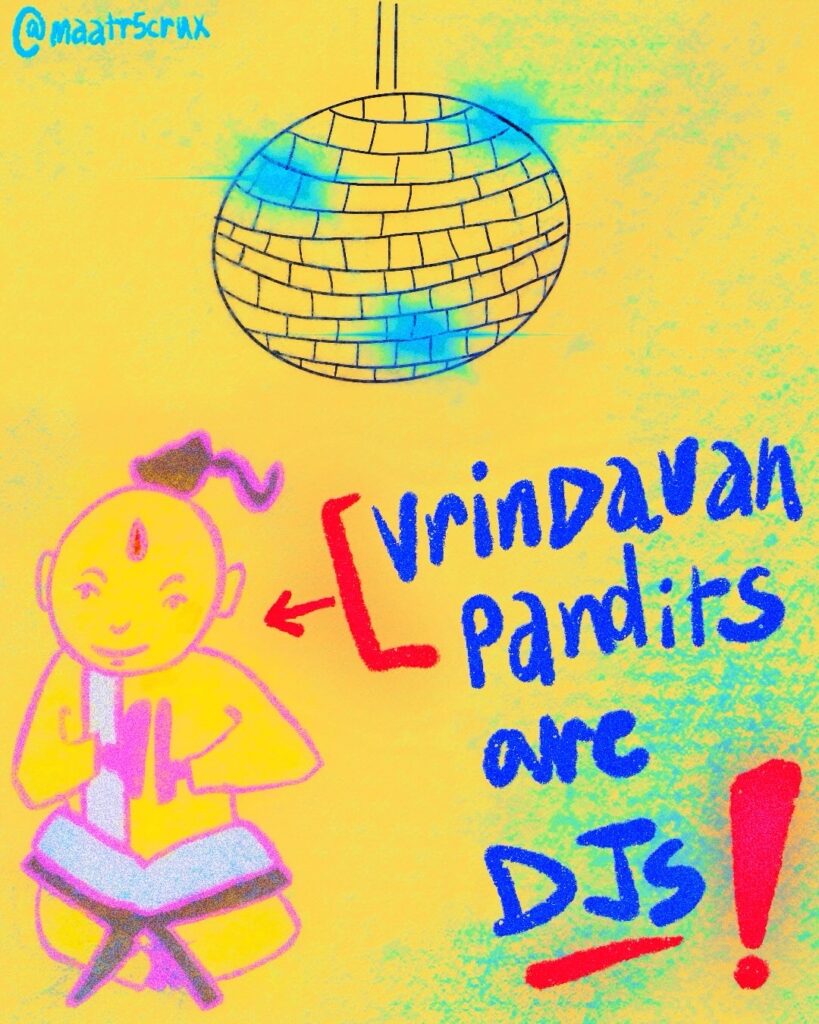
The sacred sites are no longer purely places of devotion but have become complex economic zones where the transactional nature of salvation is palpable. This cover art visually interprets this duality, contrasting the ancient Pandit figure with the modern symbol of a disco ball, a secular party element invading the sacred space.
The Architecture of Devotion vs. The Marketplace of Salvation
We observed “Oddly Specific Lawlessness.” Vrindavan operates with a different set of societal codes. The typical rules of law (such as traffic rules) are ignored in favor of an unofficial, traditional order. This leads to profound social friction, seen when the faithful are bowing down in veneration on the same streets where others are just “up walking,” creating an unstable coexistence between religious ritual and profane space.
Brahminical Capitalism and the Sanctified ‘Salesmen’
The religious economy of Vrindavan is dominated by a specific class of Brahmin pandits who act less like spiritual guides and more like commercial agents (Brahimni dakshana). Our data shows these figures are “getting shit tonnes of money,” leveraging traditional concepts of “dakshana” (spiritual offerings) to extract a “salmon of god” — a spiritual tax that benefits the keeper of the temple, not the worshipper.
Brahminical Capitalism and the Sanctified ‘Salesmen’
The modern “Pandit-as-DJ” is a powerful metaphor for this technocracy. In a highly unique observation, we noted the direct adoption of modern financial technology in sacred rituals:
“QR codes for giving dakshana to pandits.”
By making salvation scannable, the act of giving is divorced from spiritual intention, and ritual is transformed into a transaction that is as instantly accessible as a club anthem.
The Economy of Waste and the Sacred Tobacco Trade
Vrindavan showcases a fundamental contradiction between intense religious piety and physical suffering. The enormous resources (money, milk, and food) that are ritually “wasted” — offered to an inanimate idol — stand in stark contrast to the human reality just beyond the temple walls:
“Beggars outside the mandir.”
The “Anand” of ritualistic perfection (the Maha Anand) is built upon the systemic “Saza” of localized poverty.
The Economy of Waste and the Sacred Tobacco Trade
The sacred space of the temple, supposed to be purified and protected, has become contaminated by profane practices. We recorded highly unusual sights, such as the “Fulwara smoking bidi inside the temple.”
This bizarre synthesis of sacred obligation with profane addictions showcases how far the “lawlessness” has permeated the heart of the sacred, proving that Vrindavan’s sacred identity is being eroded from within by a market-driven, disorganized, and secular reality.