Authored by Shranya and Angel
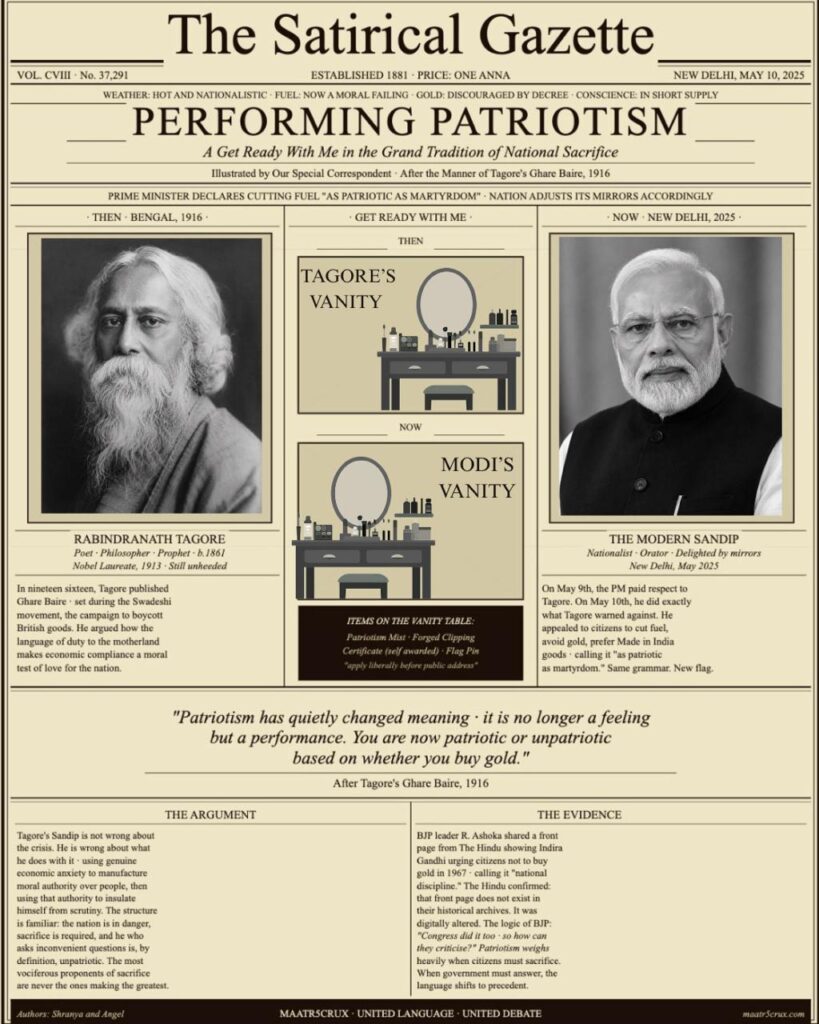
The Patriot’s Checklist
On May 9th, PM Modi paid respect to Rabindranath Tagore, and the next day he did exactly what Tagore warned against. The Prime Minister, in a public address, appealed to citizens to showcase their “patriotism” by adopting austerity measures: reducing fuel consumption, using metro and public transport, car-pooling, preferring freight trains, and prioritising Made-in-India goods. He also urged citizens to avoid unnecessary foreign travel and gold purchases, and advocated natural farming with a 50% cut in chemical usage. It is interesting to note that the statement came just a few days after a sweeping BJP victory in West Bengal. But the timing is not what interests me most. What I would like to draw attention to is something that Tagore warned us about almost a century ago. In his novel, Ghare Baire (The Home and the World, 1916), set during the Swadeshi movement — the campaign to boycott British goods and buy only Indian products — Tagore argues how the language of duty to the motherland makes economic compliance a moral test of love for the nation. This is exactly what the Prime Minister has done in his address by saying that cutting fuel consumption is “as much patriotism as martyrdom”. He is placing these two acts on the same moral register. “Patriotism” has quietly changed meaning it’s no longer a feeling but a performance. You are now patriotic or unpatriotic based on whether you buy gold.
Duty Flows Downwards
But Tagore’s warning was not only about the citizen being conscripted into patriotism. It was equally about the politician who wields that conscription. In Ghare Baire, Sandip the charismatic nationalist leader is not wrong about the crisis. He is wrong about what he does with it. He uses genuine economic anxiety to manufacture moral authority over people, and then uses that authority to insulate himself from scrutiny. The structure is familiar: the nation is in danger, sacrifice is required, and anyone who asks inconvenient questions is, by definition, unpatriotic.
Precedent as Shield
Modi’s appeal and the BJP’s response to criticism follow this exact sequence. First, frame compliance as love for the country. Then, when the opposition calls them out, BJP members do not support the appeal directly by pointing out its merits. On the contrary, they resort to history as if it were a bullet-proof shield to protect their policy. BJP leader R. Ashoka shared a news clipping of late Prime Minister Indira Gandhi supposedly urging the public not to purchase gold in 1967, terming it “national discipline.” The Telangana BJP leader even cited Nehru’s 1951 appeals for frugality during the Korean War, and P. Chidambaram’s 2013 appeal to reduce gold purchases during the UPA government. The logic: Congress did it too, so how can they be critical?
There is only one catch. The 1967 clipping from The Hindu, which went viral, is a counterfeit it is digitally altered. The Hindu officially issued a statement clarifying that the front page does not exist in their historical archives.
The Indira Gandhi government did impose restrictions on gold but through legislation, not appeals. The Gold Control Act of 1968 gave the government the authority to take coercive action rather than relying on moral suasion.
Is This What Tagore Feared?
This split “citizens, sacrifice for the country” and “critics, they did it first” nicely exposes the two-faced nature of the reasoning. Patriotism is given moral weight only when it is the citizen being asked to sacrifice. When the government is called to answer, the language shifts from principle to precedent.
Tagore saw this clearly in Ghare Baire. The most vociferous proponents of the Swadeshi movement were not the ones making the greatest sacrifices they were the ones most interested in dictating the form of sacrifice and who was publicly performing it.
Patriotic appeals can generate an atmosphere. They cannot change the fundamental structure of dependence. And a government that blames the moral behaviour of its citizens for its economic failures, while circulating false news clippings to silence criticism, is not demanding patriotism. It is demanding obedience and pretending that it is the same thing.