Authored by Pragya Gupta
From the Catwalk to the Code:
When AI stole the runway
Lights. Camera. Walk.
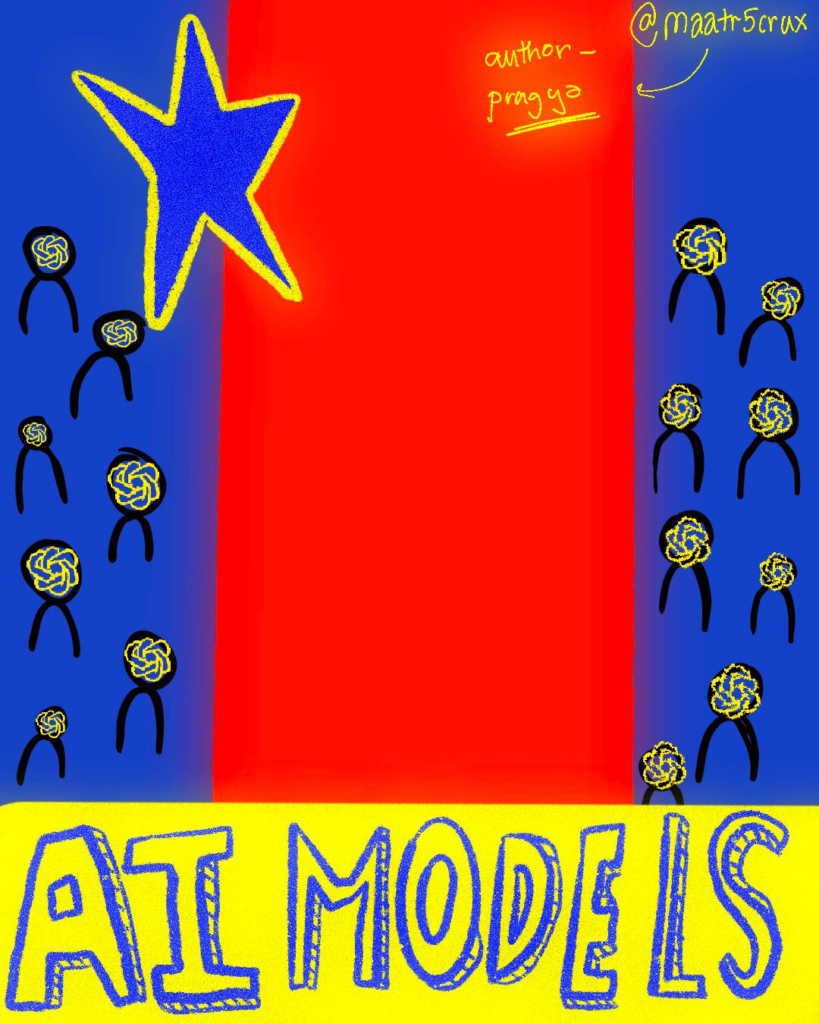
These three words describe the Nineties, a decade so extravagantly beautiful that it refuses to die and keeps resurrecting itself in every other Vogue retrospective. The supermodel era was a genuine cultural phenomenon. There is a famous story that when Kate Moss walked into a room in that era, conversation stopped. Naomi Campbell didn’t just wear clothes, she inhabited them. Linda Evangelista, bless her, famously declared she wouldn’t get out of bed for less than $10,000 a day. Then came a democratic chaos, the rise of the reality-TV model, the influencer-adjacent face, the girl-next-door with fifteen million Instagram followers. They serve as a reminder that fashion is not just about the clothes themselves, but also about using clothing to express one’s identity and convey a narrative. The interactions between models, whether it’s about Gigi Hadid walking the runway without heels or Naomi Campbell’s iconic strut or Grace Kelly’s granddaughter riding a horse to open the Chanel show, these are the events that make fashion history real. Alas, if only things were as glamorous as a Givenchy dress!
Fashion always ate its darlings eventually. Fast forward to 2025 and someone in a glass-walled office somewhere just typed a prompt, hit enter, and generated a face. Flawless bone structure, perfect eyes and a body assembled from the statistical average of ten thousand editorial shoots.
How to generate your picture perfect supermodel in seconds?
AI-generated have been lurking at the edges of the industry for a few years now. Lil Miquela, the CGI “influencer” with three million Instagram followers and a somewhat unsettling smile, debuted in 2016 and immediately caused a crisis in three separate editorial meetings. Brands loved her: no opinions, no controversy, no demands, perpetually available, infinitely scalable.
But that was the prototype era. What we’re seeing now is something categorically different. Generative AI can produce a photorealistic model image which is styled, lit, posed, and emoting. Fashion houses are already using AI-generated bodies to replace sample-size human models in e-commerce shoots. Campaign budgets that once funded a week in Ibiza with three models and a photographer now fund a single GPU subscription and an intern with a good eye for prompts. H&M created digital twins of real models for campaigns. Even, Vogue launched a feature with Guess’s AI models. Shudu Gram, billed as “the first digital supermodel,” has appeared in Balmain campaigns for nearly a decade. But what does it mean for real models and law?
The Legal Wilderness: Where IP law goes to feel confused
Law, famously, moves at the speed of a parliamentary committee reading a 400-page report over three years while technology moves at the speed of a VC-backed startup burning through runway. The gap between what AI can do and what the law has prepared for is, at present, essentially a Grand Canyon. The law does not prevent what it does not anticipate. And nobody anticipated this. Personality rights are the first battleground. In India, the concept is embedded in the right to privacy and upheld by the Hon’ble court in numerous cases.
Similar doctrines exist under the “right of publicity” in the US, though there’s no single federal law. In the EU, personality rights overlap with GDPR and image rights, which vary by member state. The short version: using someone’s face or a face sufficiently similar to theirs, without consent is legally fraught, but the exact remedy depends heavily on where you are and who your lawyers know. DPDP and the data problem nobody wants to talk about The government’s own AI Governance Guidelines explicitly state that using personal data without consent to train AI models is governed by the DPDP, and that “publicly available data cannot be assumed to be freely usable.” This creates an immediate problem for the fashion industry in India. A model who posed for a campaign shoot in 2019 signed a contract that permitted use of her images in that campaign. That contract almost certainly did not say: “and also to train a generative AI system that will then produce synthetic images replacing you in all future shoots.”
The DPDP also creates obligations for “data fiduciaries”, entities that determine the purpose and means of processing. An
AI company that trained its model on scraped fashion photography is almost certainly a data fiduciary with obligations it may not have entirely anticipated when it wrote its terms of service. What does it mean for the industry, and for actual humans?
The optimists will tell you AI models democratise fashion: smaller brands can now afford campaign-quality imagery, body diversity becomes trivially easy (just adjust the parameters), global localisation i.e. different looks for different markets, is a prompt away. These are real benefits, and they are not nothing. The pessimists will tell you that an industry that already had a fraught relationship with body image, diversity, and fair pay has now discovered it can cut out the human entirely, and that the people most affected like models from marginalised communities who fought hardest for representation will be the first to lose the gains they made. The lawyers will tell you nothing definitive until case law develops, but they will say it at a rate of ₹15,000 an hour.
What is genuinely needed is a legal framework that addresses: explicit consent requirements before any likeness is used for AI training; fair compensation mechanisms when AI systems trained on a person’s images generate commercial value; clarity on personality rights that doesn’t require a celebrity to personally fund litigation; and labour protections for creative freelancers who are displaced by automated systems.
The Bottom Line
Linda Evangelista, famously, would not get out of bed for less than $10,000 a day. The AI model doesn’t sleep, doesn’t age, doesn’t eat, doesn’t have opinions, doesn’t have a great story about the time she told off a photographer in Milan, and charges nothing at all. That should make us ask: what were we paying for, really? And who will pay the price now that we’ve found a workaround?
The runway doesn’t end here. But the cast list is about to change in ways the industry, and the law, is not fully ready for. Somewhere in a server farm, the next face of luxury fashion is being rendered. She is perfect. She is available immediately. She has no idea what she’s worth.
And that, frankly, is the whole problem.