The Theatre of Capital Punishment
Sovereignty, Calculus, and the Performance of Death
Authored by Suhani Baheti
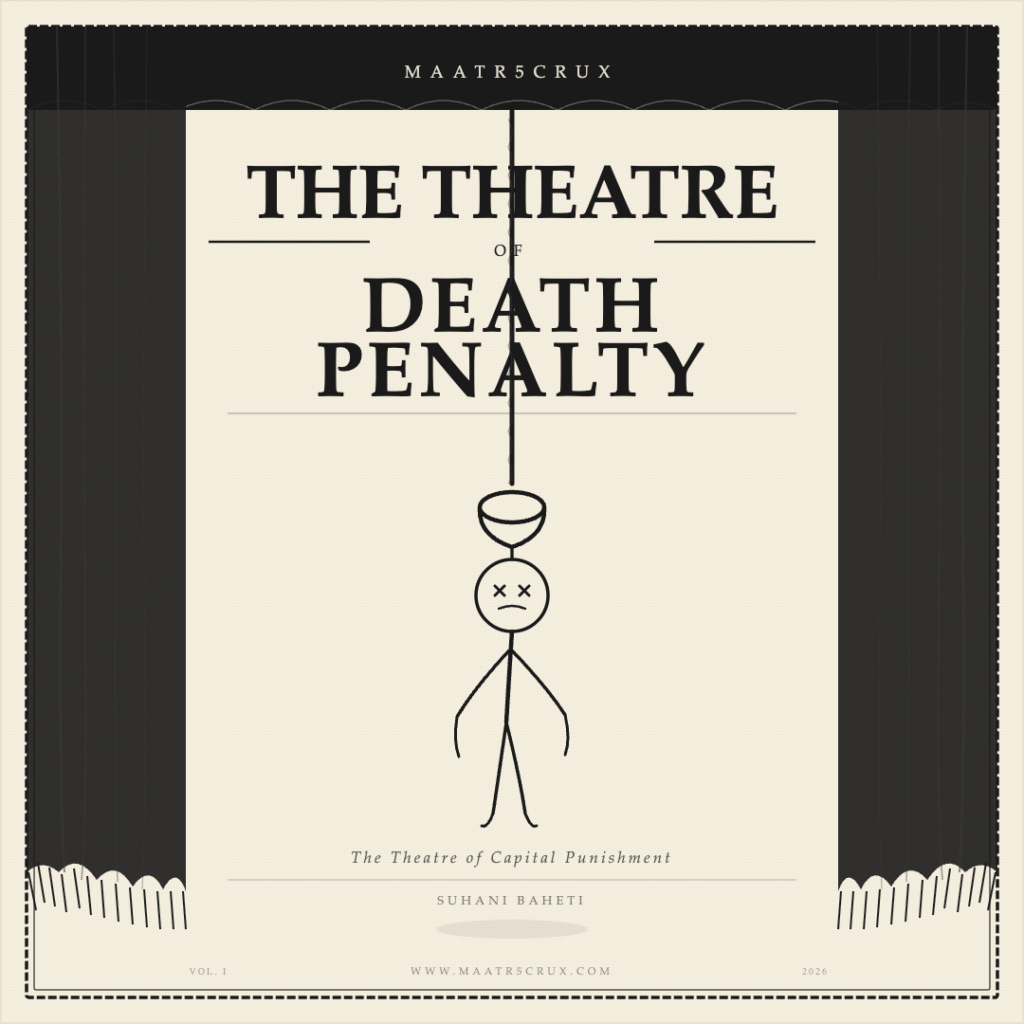
Abstract
Capital punishment in India endures not because it is rational, but because it is theatrical. This article argues that the death penalty functions as a performative act of sovereignty — one that legitimises state power through legal ritual rather than moral justification. Drawing on Foucault’s theory of sovereign power and Butler’s notion of performativity, it first interrogates the dramaturgy of the courtroom and the “rarest of rare” doctrine. It then exposes the empirical bankruptcy of capital punishment through an analysis of its disproportionate fiscal cost relative to life imprisonment, and its systemic targeting of the poor and marginalised. Through deontological critique and McLeod’s incapacitation thesis, the article demonstrates that execution is not a moral necessity but a sovereign excess. Finally, drawing on Denno’s research into execution protocols, it reveals that the state’s claim to “civilised retribution” is technically as well as morally unsustainable. The article concludes that abolition is not an act of mercy but an epistemological demand for a more rational, equitable, and honest criminal justice system.
I. The Sovereign Stage: Death as Performance
The question of capital punishment is rarely a question of who deserves to die. It is, far more fundamentally, a question of who possesses the authority to decree it and how that authority is made to appear legitimate. To understand the persistence of the death penalty within a constitutional democracy such as India, one must interrogate it through Michel Foucault’s theory of sovereign power. For Foucault, the sovereign’s ancient right to ‘make die or let live’ was not merely a political prerogative; it was a theatrical one. Public executions were spectacles engineered to manifest the absolute dominion of the state over the body of its subject the condemned was not simply punished but conscripted as a prop in a performance of state omnipotence.[1]
In the contemporary courtroom, this spectacle has not disappeared; it has been translated into procedural register and re-staged with new props. What Judith Butler identifies as a ‘performative act’ an utterance that does not describe reality but actively constitutes it now operates through legal ritual: the gravity of black robes, the solemnity of the ‘rarest of rare’ pronouncement, the clinical sterility of execution protocols.[2] Each element of this apparatus launders state-sanctioned killing as neutral, administrative necessity. The state does not merely decide to kill; it performs its authority into legitimacy, constructing a ‘collective conscience’ that is frequently more a product of institutional narrative than of genuine social demand. The scaffold has been replaced by the courtroom, but the dramaturgy endures.
II. The ‘Calculus’ of the Condemned
This performance, however, rests upon a deeply precarious internal logic. As Kas Saghafi explores in ‘Calculus’, drawing on Derrida’s seminars on the death penalty, capital punishment is the law’s attempt to calculate the incalculable: to assign a precise quantum of retribution to the immeasurable weight of a human life.[3] In the Indian context, this calculus is not merely philosophically untenable it is empirically and fiscally broken.
Monica Sakhrani and Maharukh Adenwalla have documented this failure with precision. The administrative and legal journey of a death row prisoner in India spanning decades of appeals, solitary confinement in special cells, and high-security maintenance routinely exceeds a cost of thirty lakh rupees per prisoner, a figure that stands in stark contrast to the demonstrably lower cost of life imprisonment.[4] When the state spends more to end a life than to sustain or rehabilitate one, the ‘calculus’ of capital punishment stands exposed as an economic absurdity masquerading as moral accounting.
Sakhrani and Adenwalla press further: this fiscal failure is inseparable from a systemic one.[5] The calculus of death is performed almost exclusively on the bodies of the poor, the marginalised, and the socio-economically backward those who cannot access adequate legal defence. The death penalty does not punish the worst crimes; it punishes the worst poverty. The condemned are selected not by the gravity of their acts but by the inadequacy of their counsel. This is not justice calibrated to moral desert; it is justice calibrated to structural disadvantage.
III. The Illusion of Incapacitation: A Deontological Critique
Proponents of capital punishment frequently invoke incapacitation as its central ethical justification: the state’s duty to ensure a dangerous offender can never again harm society. Yet Marah Stith McLeod, in her exhaustive analysis of the death penalty’s incapacitative rationale, dismantles this claim at its foundation.[6] McLeod argues that the duty of incapacitation does not inherently demand death. If the state can achieve total and permanent incapacitation through life imprisonment without the possibility of parole and it demonstrably can then execution is not a moral imperative but a sovereign excess: an act of finality chosen without necessity, and therefore without genuine justification.
From a deontological standpoint which evaluates the intrinsic rightness or wrongness of an action independent of its consequences capital punishment confronts a fatal internal contradiction. If the state is bound by the universal duty to protect life and uphold human dignity, a fallible adjudicative system that risks executing the innocent violates that duty at its foundation.[7] In India, the ‘rarest of rare’ doctrine has been applied with documented inconsistency across courts and jurisdictions. The so-called duty to execute justice is routinely eclipsed by a more fundamental moral imperative: to avoid irreversible, state-sanctioned error.
When incapacitation is already guaranteed by permanent imprisonment, death ceases to function as a tool of justice. It becomes a redundant ritual of vengeance one the state performs for itself, not for any compellingly rational or moral societal purpose.
IV. The Technical Breach: When the Mask Slips
The ideological coherence of capital punishment requires the state to appear civilised, clinical, and categorically superior to the violence it purports to punish. This explains the historical shift from public hangings toward ostensibly ‘humane’ methods: death repackaged as medical procedure, as though sedation could dissolve moral responsibility. Yet Deborah W Denno’s research into execution protocols demonstrates that this veneer of humanity is frequently a technical façade.[8] Her analysis of lethal injection chaos marked by botched procedures, inadequate pharmaceutical protocols, and undertrained personnel reveals that the execution chamber is often a site not of law, but of torture.
The Indian context compounds this critique with its own opacity. The secrecy surrounding domestic execution protocols, the absence of scientific transparency regarding the mechanics of judicial hanging, and the lack of any rigorous independent audit of these methods render the state’s claim to ‘civilised retribution’ constitutively unstable.[9] When the technical apparatus of state killing fails or is revealed to be archaic, imprecise, or dependent on the competence of a single executioner the institutional mask slips. What is exposed is not an infallible legal machine, but a bureaucracy susceptible to the same human error and procedural failure as any other arm of the state.
This technical instability reinforces a deeper jurisprudential argument: the state cannot ethically claim the authority to perform an irreversible finality death when its methods are inherently experimental, inconsistent, and unverifiable.
V. Conclusion: Beyond the Theatre of Retribution
Viewed in its totality, capital punishment in India cannot be examined in isolation from the socio-legal structures that produce it. It is a theatre of retribution one in which the state attempts to calculate justice at a moral and fiscal cost it cannot sustain. Whether analysed through the Foucaultian lens of sovereign power, the empirical critique of structural bias documented by Sakhrani and Adenwalla, the deontological imperative against irreversible error articulated by McLeod, or the technical fallibility of execution methods exposed by Denno, the conclusion converges: capital punishment fails on every register it claims to succeed.[10]
For a legal system genuinely oriented toward restorative justice, the imperative is clear. The focus must shift — decisively and irreversibly from the performance of death to the rigorous mitigation of life. True justice is not located in the finality of the noose; it is found in the interdisciplinary investigation of the systemic failures poverty, mental illness, legal inadequacy, and social marginalisation that conduct an individual to the gallows in the first place. Abolition, on this account, is not sentimentality. It is an epistemological demand: a rejection of a broken calculus, a refusal of a performative sovereignty, and an insistence that a criminal justice system worthy of the name must confront its own fallibility with honesty rather than ceremony.
[1]Michel Foucault, Discipline and Punish: The Birth of the Prison (Alan Sheridan tr, Vintage Books 1977) 48–49.
[2]Judith Butler, Excitable Speech: A Politics of the Performative (Routledge 1997) 2–5.
[3]Kas Saghafi, ‘Calculus’ in Kelly Oliver and Stephanie M Straub (eds), Deconstructing the Death Penalty: Derrida’s Seminars and the New Abolitionism (Fordham University Press) 143–145.
[4]Monica Sakhrani and Maharukh Adenwalla, ‘Death Penalty: Case for Its Abolition’ (2005) 40(11) Economic and Political Weekly 1023, 1024.
[5]ibid 1025.
[6]Marah Stith McLeod, ‘The Death Penalty as Incapacitation’ (2018) 104 Virginia Law Review 1123, 1130–1135.
[7]ibid 1145–1148.
[8]Deborah W Denno, ‘Lethal Injection Chaos Post-Baze’ (2014) 102 Georgetown Law Journal 1331, 1340–1345.
[9]ibid 1355–1360.
[10]Sakhrani and Adenwalla (n 4) 1025; McLeod (n 6) 1190–1195.