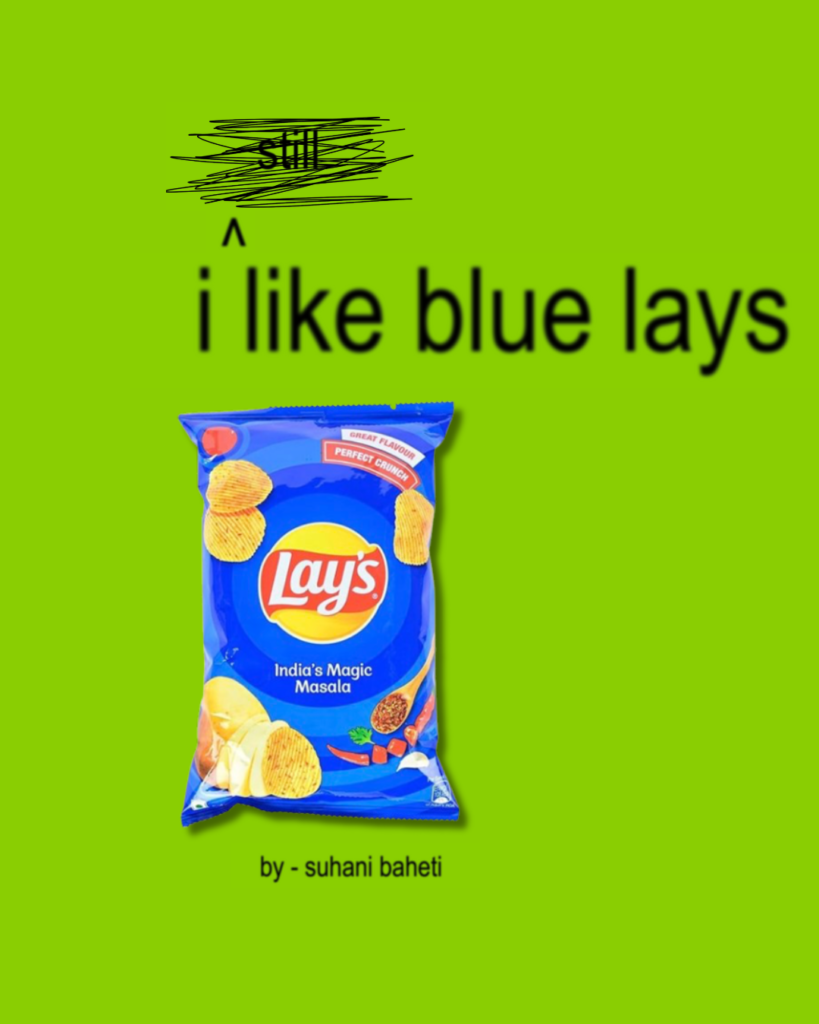
there, i said it.
and honestly, i can’t remember the last time a blue lays packet wasn’t somewhere in my room, sometimes crumpled, sometimes intact, sometimes functioning as a meal replacement and sometimes as emotional scaffolding. i’ve eaten it at ten, at seventeen, and now.
i’ve eaten it sad, happy, bored, overthinking, under-eating, while writing essays, or while doing absolutely nothing.
it occupies this strange emotional category:
full yet not full, a meal yet not a meal, comforting yet insufficient.
A snack that behaves like memory.
which brings me to the real question:
how did blue lays become so absurdly consistent in india, a country built on masala, bhujia, halwai culture, and spice-driven identity?
india eats with intensity, mithai and namkeen, sweet and salty, chaat and dabeli. Our national palate has a voltage of its own. by that logic, Cream & Onion should’ve been a flop the day it landed here. it isn’t chatpata. it isn’t masaledaar. it isn’t even pretending to be Indian.
and yet, it succeeded.
effortlessly. repeatedly. across generations.
because PepsiCo cracked something every Indian brand missed:
Indians don’t eat with taste.
Indians eat with nostalgia, familiarity, and aspiration.
balaji is indian. haldiram’s is Indian. bikaji is indian.
But none of them created a flavour that made people feel vaguely international and vaguely comforted at the same time.
blue lays is that paradox.
foreign on paper, indian in practice.
the namkeen nationalism moment (that changed absolutely nothing)
when the redesigned lays packet dropped, india’s Rs 40,000+ crore snack economy had a meltdown. the crowd that swears by “extra masala please” suddenly turned into cultural critics:
“Humara neta masala chahta hai, yeh videshi flavour bahar!”
we temporarily became soldiers for bhujia nationalism.
but let’s look at what actually happened:
did sales drop? No.
did the price drop? Absolutely not.
did outrage matter? Only on reddit.
did blue Lays lose its throne? Never.
because outrage is seasonal. loyalty isn’t.
modi ji & IPL
if you look at the marketing, it’s almost cinematic to imagine how it was decided.
like they locked Modi ji in a dark room and asked,
“Batao, Indians like what other than masala?”
and after religion and politics, he said:
“Cricket.”
so PepsiCo did exactly that.
they pulled up with the holy trinity of Indian influence:
IPL, Cricketers, Celebrities
cricketers, actors, influencers they’re the actual gods in this country. we chant their names more consistently than we chant national slogans. if they’re holding a Blue Lays packet in an IPL ad, that’s not marketing that’s prasad.
blue lays stopped being “just a snack” and became a prop in the religion of everyday Indian life:
ad breaks during IPL, teenagers watching matches in hostels, families sharing chips in living rooms, celebs doing fake over-acting crunch faces between overs, PepsiCo didn’t just market flavour.
they embedded it into ritual.
Why Don’t We Eat Anything Else?
when I tried listing other chip brands i regularly eat, i failed.
balaji? maybe on trains.
pringles? at airports.
doritos? when someone else pays.
blue lays is default.
baseline.
synonymous with “chips.”
and what’s worse?
the competition within Lays is its real ecosystem:
Blue and Green: the ruling class, og!!!!
Dark Green & Orange: niche underground rappers
Yellow: wannabe, underrate, nice with coke.
Red: once in a while, for kids…… (jokes) (maybe not)
blue is not just a flavour.
it is a hierarchy.
pepsico’s genius: making indians feel indian with a foreign snack
pepsico understood something Indian companies still treat like a TED talk topic:
Indians don’t buy products.
Indians buy emotional continuity.
this is why Lays succeeded where Balaji, Haldiram’s, and even Pringles couldn’t:
it felt modern but not intimidating. western but not alien. imported but affordable. familiar but aspirational.
indianised without being “masala-ified.”
the great shrinkflation crime we all pretend not to notice
but let’s talk crime.
the Rs 10 pack used to be 28 grams.
then 22g.
then 19g.
now 16g and vibes.
lays is practically 80% air at this point , the great indian doritisation.
input costs rose.
palm oil prices shot up.
packaging got expensive.
logistics exploded.
and pepsico responded exactly how every big FMCG company responds:
take away the chips, never the nostalgia.
and we masters of selective outrage accepted it.
we’ll argue about netflix prices, petrol prices, GST slabs, everything
but blue lays?
we quietly sip the air and crunch the crumbs.
blue vs yellow: the most serious research you’ll read today
flavour stability
blue: consistent, creamy, reliable
yellow: oxidises, shifts flavour, changes personality like a politician
market performance
blue: two decades of uninterrupted dominance
yellow: reinvents itself every election season (cheese? masala? who knows)
demographic appeal
blue: pan-India, pan-class, pan-mood
yellow: region-specific, nostalgia-agnostic
brand memory
blue: instantly recognisable
yellow: constantly mistaken for magic masala (tragic)
who even competes with blue lays?
pringles sour cream & onion
same flavour family.
loses on: price, accessibility, distribution, relatability.
a snack for airports, not hostels.
mad angles
masala-coded.
competes with yellow, not blue.
haldiram’s chips
strong masala flavours.
not in the “international” lane.
too yumm / cornitos
premium. fitness-coded.
different taxpayers altogether.
final verdict:
Blue Lays has no real competitor.
It occupies a monopoly built on taste, nostalgia, distribution, and flawless psychological targeting.
so why is blue the “IT” colour?
because blue is india’s fantasy of modernity, not too foreign, not too familiar.
bold but safe.
premium but affordable.
aspirational but accessible.
it’s the flavour that survived nationalism, health consciousness, inflation, packaging redesign, and 20 years of Indian emotional volatility.
blue lays isn’t just a snack.
It’s Indian cultural infrastructure.
and the truth is simple:
i still like blue lays.
and so does india.
i love u lays.