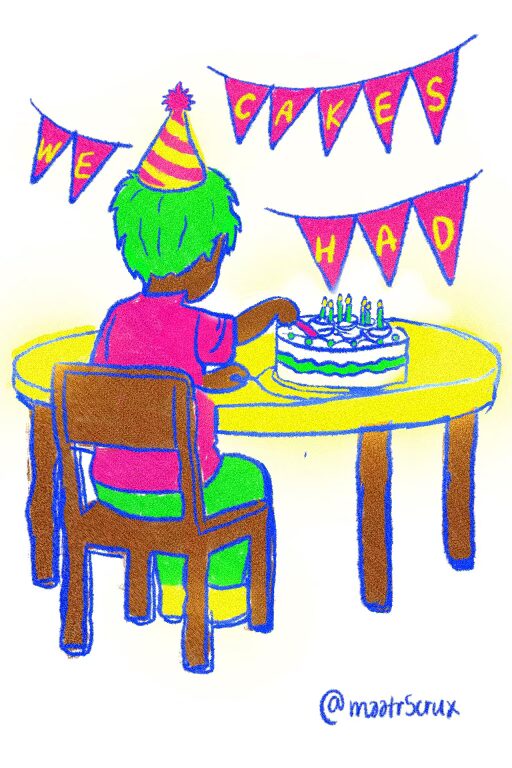
Children’s birthday cakes are among the earliest public objects through which identity is expressed without fear almost like the Great Bath of Mohenjo-daro my history teacher taught us about in 7th grade, which sounded profoundly ritualistic until you realised it was, functionally, just a swimming pool. The meaning is not hidden, symbolic, or self-conscious.
It is literal. Visible. Uncomplicated.
Animal cakes, cartoon characters, Barbie cakes, dinosaurs with mismatched eyes and too much icing dominate early childhood not because they are tasteful, but because taste is irrelevant. At this stage, preference is uncomplicated by reputation. A child does not choose a dinosaur cake to signal irony, confidence, or aesthetic awareness. They choose it because dinosaurs matter. That is the full explanation.
Psychologically, this makes sense. Meaning in childhood is external and symbolic rather than abstract or defensive. Desire does not yet require justification. The cake functions as an extension of play. It is not designed to be interpreted, curated, or defended. It is designed to be eaten. Destroyed. Forgotten. No one asks what the cake means. No one asks if it photographs well. No one asks if it is “too much.”
Children do not anticipate judgement.
That is the real privilege of childhood.
Children’s birthday parties are shamelessly wholesome in ways adulthood later learns to distrust. There is a dress code, but it is celebratory, not aesthetic. Everyone is overdressed on purpose. Someone is wearing sequins at 3 p.m. for no reason other than joy. There are temporary tattoo artists painting butterflies and dragons on forearms that will be scrubbed off by night, and no one treats this as unserious.
No one is drunk.
Everyone is high on Fanta.
There are games badly organised, loudly enforced games run by your masi, your mum, your dad, someone’s overenthusiastic uncle who insists everyone participates. Musical chairs. Passing the parcel. Dumb prizes. Loud cheering. There are clowns and jokers whose job is to entertain the room, not dominate it. The point is collective fun, not individual performance.
You give chocolates to everyone. Not as a favour. Not as a flex. Just because that is what birthdays require. The cake is aggressively unhealthy. Fondant animals that taste like regret. Colours that should not exist together. No one asks about ingredients. No one asks if it aligns with their values. The cake is not gluten-free. It is not vegan. It is not clean. It is joy-shaped and slightly disgusting, and that is allowed.
Childhood cakes exist in a space without surveillance. They are allowed to be excessive, colourful, emotionally legible. Visible liking carries no social cost. Joy does not need to disguise itself as taste.
Adulthood is where this permission collapses.
Adult birthday cakes are publicly visible and socially interpretable, which makes them political objects. They begin to reflect class alignment, gender norms, cultural belonging, and how safe a person feels being seen. Expression invites interpretation. Interpretation invites judgement. In such environments, neutrality becomes strategy and strategy becomes taste.
This is why adult birthday cakes look the way they do: beige, minimalist, abstract, described with words like “clean,” “classy,” or “mature.” But plainness is not neutral. It is learned. Excess becomes risky. Decoration becomes suspicious. Literal joy is replaced by abstraction. What we call “aesthetic” is often just the ability to disappear convincingly.
Taste, in adulthood, is no longer about pleasure.
It is about avoiding misinterpretation.
We pretend this is sophistication. It is not. It is discipline.
It is tempting to call adult cake culture pretentious, but pretentiousness implies falsity that people are lying about what they like. That is too generous. The truth is worse. Adults are trained to anticipate critique and adjust accordingly. Seriousness is not an achievement; it is a defence. What we celebrate as maturity is often just the internalisation of surveillance.
Adult birthdays replace clowns with anecdotes about stupid exes. Games are replaced with beer pong. Collective joy is replaced with ironic detachment. Drinking becomes compulsory. Caring becomes embarrassing. Cakes now arrive with disclaimers gluten-free, refined-sugar-free, “clean.” What is framed as health-consciousness often doubles as aesthetic policing. Even pleasure must now justify itself.
This is not progress.
It is editing.
The shift from animal and Barbie cakes to neutral aesthetics does not mark emotional growth. It marks caution. Childhood permits visible desire. Adulthood permits desire only when it is disguised as taste. And this shift is not evenly distributed. Class determines who can afford aesthetic restraint. Globalised taste dictates what seriousness looks like. Parental anxiety often shapes children’s cakes long before children learn to self-police.
The adults who still choose playful, “childish” cakes are rarely naïve. They are secure. They can afford to be unserious without consequence.
That is the quiet truth behind the minimalist cake.
What birthday cakes ultimately reveal is not that we lose imagination as we grow up. It is that permission narrows. Growing up does not teach us what to enjoy; it teaches us how carefully enjoyment must be presented in order to remain acceptable.
We did not stop liking colourful, ridiculous, excessive things.
We just learned which versions of joy are safe to show in public.
We cakes had.
Now we cakes perform.
And once you see that, you can’t unsee it.
Now you know what kind of cake to get me for my coming birthday 😉 LOL