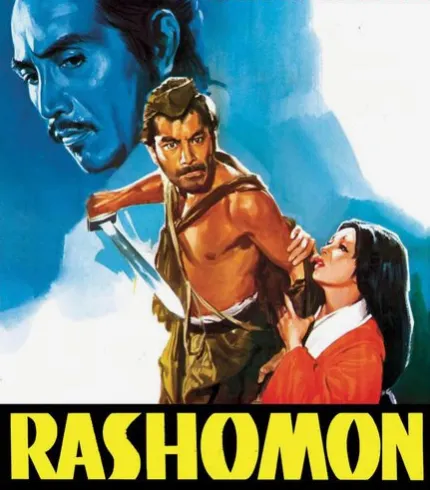
“Law, Justice, and Human Perspective: An Explanation through Complexity”
The thematic depth, dramatic complexity, and mundane details of Rashomon will entwine a very well-depicted view of law, justice, and human perspective on the truth. This Japanese classic tells its story with the help of characters with different perspectives where every person presents a version of an incident. Three main witnesses form the backbone of this narration, and the protagonist ominously warns that the tale about to be told is unlike any sermon ever heard in the history of sermons-it’s a chilling one. The chapter starts with rains pouring on and multi-layer and multi-plotting though the central elements stay the same: a samurai, his wife, and a bandit.
How should justice be served in such a scenario?
Judges would have to strip the testimonies down to their core truths, seeking accountability in every single witness’s statement. Yet as Kafka argues, the law is subjective; thus, each judge would understand it differently. Even when the testimonies are true, a judge may still be sceptical of whether they are saying something genuinely authentic or not. This is because the testimony of the deceased samurai is communicated through a spirit medium. While it is often said that dead men tell no lies, can we even accept absolute goodness? Perhaps goodness itself is an illusion, some comfortable fiction people hang on to forget the hard realities of life. Being “good” may be nothing more than a social construct, a needed face we keep up to placate ourselves.
In fact, it may provoke some to question the legitimacy of the testimony of the samurai himself. How would he explain things in the afterlife? The story of his being passed down by his widow provokes more questions about his credibility and whether or not he is wracked by sin, guilt, and personal motivations.
Character Analysis Through a Justice Lens
In the middle of a world that is slumped in the dregs of power imbalance and justice’s delay, there is a distortion of worldview. One illustration is the bandit. Psychologically, the account of his story is full of “mansplaining” and the urge to dominate through a violent duel. He is cunning, immoral, and an erotic man: his motivation to pursue the samurai was strictly a result of his sexual desire for the wife of the samurai, an example of the mythological tale of Ravana.
In the wife’s account, we find the kind of tactful, emotional response that the woman repressed by societal norms would expect to make. Instead of crying her husband’s death, she obsessed over her trauma, a situation that portrays how women are usually forced to navigate their sufferings within limitations that society has set for them. Her testimony reflected a mix of anger, anguish, and compassion, drawing a line to define her emotional actions.
However, the account of the samurai is all heartbreak. His wife’s betrayal, and her request for the bandit to kill him, left him dazed in the sense that he could not fathom how such a thing could happen. Even the brazenness of the bandit was rattled by her heartlessness.
Each testimony in Rashomon offers a different, sensible point of view driven by personal prejudices, traumas, and power imbalances. Character sketches of the kaleidoscope of evidence serve for each spectator as something to think about what might be real or not.
‘To each his gate, and each gate, a keeper.’
Legal Positivism vs. Natural Law
Legal positivism, the fact that law is based on codified rules and proceedings, is well represented in a typical courtroom the whole process of which is followed according to official channels of justice, bringing into account the judiciary, legislature, and media towards public perception. Rashomon, however, also takes into account natural law-which in a more moral and humanistic approach to justice sustains ideals that are truly universal and moral. Throughout the movie, we see that legal judgments are not made solely on evidence but take into account emotional and hypothetical considerations as well. In this sense, law is not just an objective construction but is linked with subjective moral judgments.
Psychological Analysis of the Testimonies
The psychological characterization of each character in the movie narrates the depth of the mind and conviction. For instance, the outlaw posed as a hero swordsman instead of an outlaw. His testimony is that of a man suffering from narcissistic personality disorder; his ego was puffed up. The wife, on the other hand, is shame- and guilt-ridden; she is messed up with her thoughts and emotions. Instead of having her account steady, she seems to be in a psychological duel with herself.
In Rashomon, all characters are both untrustworthy and glaringly human, so the pursuit of truth becomes, in fact, not just a test for law but also for humanity at large.